

Five community leaders recognized for preserving the stories of Waipahu’s athletes, coaches and mentors
A piece of Waipahu’s history has returned to Hans L’Orange Baseball Park, thanks to five community members determined to preserve the legacy of the athletes, coaches and leaders who helped shape their hometown.
Honolulu City Councilmember Augusto “Augie” Tulba recently honored Ann Asakura, Gail Harada, Deborah Pope, Dennis S. Kodama and Grover Ishii at the Honolulu City Council for their efforts to restore the Waipahu Sports Legends Monument, originally dedicated in 1999 to recognize 19 individuals whose athletic accomplishments and community contributions inspired generations.
After years of deterioration, the monument was decommissioned, leaving an important chapter of Waipahu’s history at risk of being forgotten.
The five honorees refused to let that happen. They researched the monument’s history, raised funds and worked to bring it back to the community where these sports legends first made their mark.
“These 19 names are more than names on a monument,” Tulba said. “They tell the story of Waipahu, the people who helped build our community and the generations they inspired. Thanks to these five dedicated individuals, their stories will continue to be told.”
A Community Built Around Sports
Waipahu’s athletic legacy stretches back more than a century.
In 1924, Hans L’Orange helped set aside plantation land for recreation, creating a gathering place where families could enjoy sports and young people could develop their talents.
That land eventually became Hans L’Orange Neighborhood Park, a place where generations of Waipahu residents competed, formed friendships and pursued their dreams.
Among them was Henry “Prince” Oana, who grew up playing baseball in Waipahu before becoming the community’s first Major League Baseball player.
Another hometown legend, James Moniz, established himself as one of Hawaiʻi’s greatest endurance cyclists. In 1936, Moniz completed a grueling 106-mile bicycle race around Oʻahu in just over five hours, setting a record that stood for 40 years.
Despite his extraordinary achievement, his daughter remembered him as a humble man who simply loved riding his bicycle.
Walter Gouveia earned national recognition for his accomplishments in volleyball and distance running. He made headlines when he competed barefoot in the Boston Marathon and finished an impressive 10th overall.
Although Gouveia had opportunities to leave Hawaiʻi and pursue Olympic training, his connection to home remained strong.
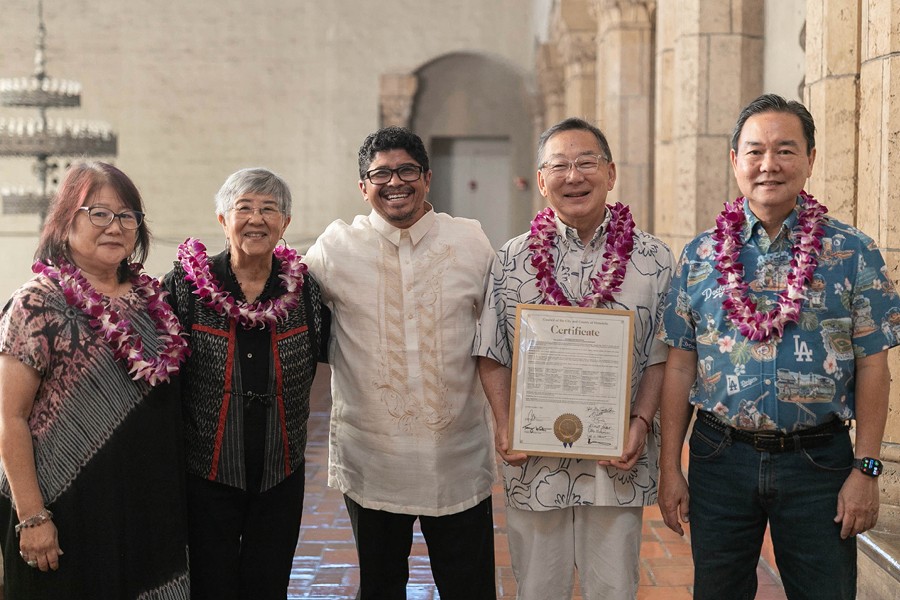
For Ann Asakura, Gail Harada, Deborah Pope, Dennis Kodama and Grover Ishii, restoring a piece of Waipahu’s history meant ensuring the contributions of past generations would continue to be remembered. Photo: Josh Koh
Waipahu’s Fighting Spirit
Waipahu also developed a remarkable boxing tradition that produced champions and inspired generations of young fighters.
Among its legendary names were Andy Ganigan, Al Silva, members of the Yasui family and Jesus Salud.
Ganigan became famous as “The Hawaiian Punch,” earning his nickname through his devastating punching power and exciting performances in the ring.
His legacy extended far beyond his own boxing career.
World champion Jesus Salud later encouraged another promising young Waipahu boxer, Brian Viloria, to carry on the nickname “The Hawaiian Punch.”
Viloria went on to become a world champion himself, continuing a tradition that connected generations of Waipahu fighters.
For Tulba, who grew up in Waipahu, these boxing legends were particularly meaningful. Their accomplishments showed young people that athletes from their own neighborhood could compete with the best in the world.
The monument also recognizes other outstanding figures, including Takemi Arakawa, Mac Flores, Kenneth Kimura, Kats Kojima, Cris Mancao, Ricky Oamilda, Brown Watabu and Masa Yonamine.
Their accomplishments spanned different sports and generations, but their stories shared a common beginning in Waipahu.
Many also gave back to their community as coaches, teachers and mentors, helping younger athletes discover their own potential.

A press conference unveiling the new monument was on September 25, 2026. Photo: Josh Koh
Honoring Those Who Gave Back
The monument celebrates more than athletic records and championships. It also recognizes people whose dedication to young athletes helped strengthen Waipahu.
Among them was Dr. “Doc” Noda, a physician who cared for generations of plantation families and helped establish the Waipahu Jackrabbits youth sports league.
Through the Jackrabbits, children gained opportunities to participate in organized sports, develop confidence and learn teamwork.
Parents, coaches and volunteers raised money, organized activities and ensured that young athletes had uniforms, equipment and a place to belong.
Their efforts helped create a community sports tradition that extended far beyond the playing field.
Tulba said the restored monument offers an important reminder that athletic success often begins with someone willing to encourage a child, volunteer as a coach or provide an opportunity.
“Greatness can begin right here in Waipahu,” Tulba said. “These athletes showed us what determination, hard work and perseverance can accomplish. Just as important, they remind us how much it means when someone believes in a young person and helps them succeed.”
Preserving History for Future Generations
The restoration ensures that future generations can learn about the people who helped establish Waipahu’s reputation for athletic excellence, community pride and perseverance.
It also restores a connection between the community’s plantation history and the athletes who emerged from its neighborhoods, schools and playing fields.
For the five individuals responsible for bringing the monument back, the project required research, fundraising, collaboration and a commitment to preserving stories that might otherwise have faded from public memory.
Tulba recognized Asakura, Harada, Pope, Kodama and Ishii with honorary certificates signed by all nine councilmembers for their contributions to Waipahu and their dedication to preserving its history.
"Their work has given residents and visitors an opportunity to rediscover the remarkable people who helped shape the community," Tulba said.
The restored Waipahu Sports Legends Monument now stands as a lasting tribute to hometown heroes whose achievements reached far beyond Waipahu, and to the neighbors who made sure their legacies would never be forgotten.
Category Tag:
Share this story
Subscribe to the District 9 mailing list
Receive mid-month and end of month updates, sent directly to your email!


