
Visitors who walk through Hawaiʻi’s Plantation Village in Waipahu step into a carefully recreated world of early plantation life.
The village reflects the traditions of Chinese, Portuguese, Puerto Rican, Japanese, Korean, Filipino, and Spanish immigrants who arrived in Hawaiʻi in the late 1800s and early 1900s to work in the sugar industry. Plants and herbs surrounding the homes, including lemongrass, achiote, and fruit trees, represent what families used for cooking and medicine, often brought from their homelands.
The authenticity of the village is the result of the vision and work of architect Spencer Leineweber. Historian Yoshiko Yamauchi, who helped select the project’s designer, recalled, “We went with Spencer. This was her story. She had a vision for this area and how to preserve the plantation lifestyle of people back then.”
Through extensive research, including historic photographs, field measurements, archival drawings, and interviews with plantation workers and their families, she helped recreate buildings that reflect the diverse communities who shaped Hawaiʻi.

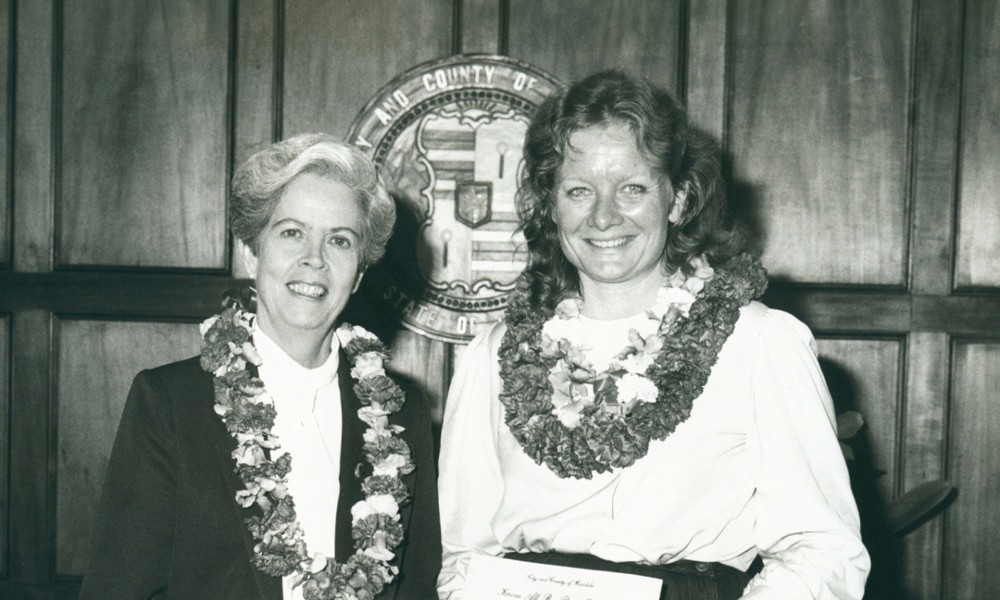
The Honolulu City Council presents and Honorary Certificate to Architect Spencer Leineweber. Photo by Tom Hisamura courtesy of University of Hawaii-Manoa Library.
Today, the village includes a 1930s barbershop, a saimin shop, a traditional tofu house, and a communal Japanese bathhouse. Many of the items inside were donated by descendants of plantation families, adding to the authenticity of the experience.
Set on 50 acres of land donated by the former Oʻahu Sugar Company, the site illustrates how plantation life evolved over time. Early camps housed single laborers in communal dormitories, later transitioning to small family homes as workers brought their families to Hawaiʻi.
Yamauchi noted, “Between 1852 and 1946, nearly 400,000 workers came here to work in the sugar industry. They brought their culture, recipes, plants, and traditions with them. That history is the foundation of modern Hawaiʻi.”

Leineweber poses for a photo with 6 of her family members at the Hawaii Convention Center. Photo courtesy: Historic Hawaii Foundation
Throughout her career, Spencer Leineweber remained committed to preserving Hawaiʻi’s historic places. Her work included projects such as Varona Village in ʻEwa, restoration efforts at ʻIolani Palace, historic homes across the islands, and buildings in Honolulu’s Chinatown. She also taught at the University of Hawaiʻi at Mānoa, where she led graduate programs and the university’s Heritage Center.
She believed history should be shared with the public. In 1996, she partnered with Mālama Mānoa to lead walking tours highlighting historic homes built in the 1920s and 1930s.
Alongside her husband Michael, she was a charter member of the Historic Hawaiʻi Foundation and remained active in preservation efforts for decades. Her contributions were recognized with numerous honors, including the Historic Hawaiʻi Foundation’s Frank Haines Award for Lifetime Achievement in 2013.
Spencer Leineweber passed away in Honolulu in 2015 at the age of 68, but her legacy continues.
Today, Hawaiʻi’s Plantation Village stands as a lasting tribute to the immigrant communities who helped build the islands and to the architect who ensured their stories would be preserved for generations to come.

Spencer Leineweber's legacy can be seen through the many exhibits she built at Hawaii's Plantation Village in Waipahu. Photo courtesy: Hawaii's Plantation Village
Category Tag:
Share this story
Subscribe to the District 9 mailing list
Receive mid-month and end of month updates, sent directly to your email!


