

Every spring, Honolulu's budget season becomes one of the clearest windows into what the City and County of Honolulu plans to do, what it can afford, and what residents can still influence before the next fiscal year begins.
For Fiscal Year 2027, the Honolulu City Council's review runs from March through June 2026. During that period, Councilmembers examine the Mayor's proposed executive operating and capital budgets, the legislative branch budget, the Honolulu Authority for Rapid Transportation budget, and the revenue measures that help pay for them. The process is public, amendment-driven, and time-limited: the Council must adopt the budget and revenue program by the charter deadline in June.
What the FY27 Budget Is
The FY27 budget package covers the fiscal year from July 1, 2026, through June 30, 2027. It includes several related measures that move through the Council together:
Executive Operating Budget: The day-to-day budget for City operations, including salaries, services, supplies, equipment, and other recurring costs. The Mayor's proposed FY27 operating budget is about $3.97 billion, a 0.97% increase over the adopted FY26 operating budget.
Executive Capital Budget and Program: The budget for long-lived projects, facilities, equipment, and infrastructure. The proposed FY27 capital improvement program is about $1.11 billion, approximately $172.1 million less than the adopted FY26 capital budget.
General Obligation Bond Authorization: A companion bill that authorizes bond financing for eligible capital budget projects.
Revenue Program and Real Property Tax Rates: Measures that identify where the City expects to get its money, including taxes, fees, bond proceeds, and other revenue sources. For FY27, projected operating resources total about $4.74 billion.
HART Operating and Capital Budgets: Separate operating and capital budgets for the Honolulu Authority for Rapid Transportation, the semi-autonomous agency responsible for the rail project.
Legislative Budget: Funding for the City Council and legislative branch offices, including Council Services, the City Clerk, and the City Auditor.
According to the Mayor's executive budget materials, the proposed combined operating and capital budgets total about $5.09 billion, which is $133.6 million less than the combined FY26 adopted budgets.
Major operating revenue sources include about $1.79 billion in real property tax revenue, $515 million in sewer service charges, and $106.7 million in Oahu Transient Accommodations Tax revenue.
Why This Budget Matters
The Council frames the FY27 budget review around trust, affordability, basic services, and quality of life. Residents are facing high costs, and the Council's budget page emphasizes that public dollars should be tied to outcomes people can see: safe streets, maintained public spaces, reliable services, working infrastructure, and transparent decision-making.
The Mayor's executive budget materials describe a similar fiscal environment: modest economic growth, relatively flat real property tax revenue, rising operating costs, collective bargaining salary and benefit increases, homelessness service needs, and technology investments. The administration's stated approach is to constrain spending, avoid increasing real property tax rates, modernize government operations, and focus on core priorities.
Taken together, the budget is trying to answer a hard civic question: how can Honolulu maintain and improve services while limiting avoidable cost-of-living pressures on residents?

Discussing a few budget items with Councilmember Nishimoto. Photo Courtesy: Council Support Services / Justin Gerald Ocampo
The Major Goals Behind FY27
The FY27 materials point to several broad goals all aimed at providing a more functional way of spending across the City & County of Honolulu. The budget is not just a set of spreadsheets. It is the annual decision point for how Honolulu funds basic services, public safety, parks, roads, housing, rail, wastewater, climate work, permitting improvements, and the capital projects that shape daily life on Oahu. It is also where Councilmembers test whether proposed spending matches fiscal reality, district needs, and residents' concerns about affordability.
1. Keep Government Spending Disciplined
Both the Council page and the Mayor's proposed budget stress fiscal restraint. The Council says its review is intended to hold the full budget accountable to fiscal reality, while allowing amendments that respond to district-level needs. The Mayor's executive summary says the budget was prepared conservatively in response to slow growth, flat revenue expectations, and rising operating costs.
In practical terms, that means the Council is looking not only at what programs cost, but whether departments can justify new spending, vacancies, overtime, federal fund use, fee increases, and capital projects.
2. Protect Core City Services
The budget prioritizes the everyday functions residents notice quickly when they fail: public safety, emergency services, roadways, parks, public facilities, transportation, waste and sewer systems, permitting, and maintenance.
The Mayor's materials name first responder operations and facilities, parks, roadways, bridges, wastewater infrastructure, transit operations, traffic technology, fiber and broadband connectivity, public-facing facilities, and transportation electrification among the areas receiving attention.
3. Address Affordability and Housing
Affordability is a central theme. The Mayor's proposed budget identifies affordable housing as a priority, including the continued development of the Department of Housing and Land Management and a focus on lower-cost housing near transit-oriented areas such as Iwilei.
The budget also includes dedicated affordable housing and land conservation-related fund reports, along with operating and capital allocations tied to housing, homelessness, and public infrastructure planning.
4. Expand Homelessness Services
The executive budget materials highlight continued and expanded homelessness services, including outreach, navigation, medical triage, respite, transitional shelter, housing, and wraparound services in coordination with the State and community partners. The Mayor's transmittal letter identifies approximately $10.5 million in ongoing and enhanced homeless services as one of the pressures built into the FY27 operating budget.
5. Modernize City Operations
Modernization appears throughout the FY27 materials. The Mayor's budget emphasizes permitting improvements at the Department of Planning and Permitting, technology investments, process improvements, and operational efficiencies. The transmittal letter specifically identifies about $7.7 million in Department of Information Technology enhancements.
The larger goal is to improve public service while reducing avoidable cost, delay, and friction in government.
6. Continue Rail and Transit Integration
The FY27 package includes HART's capital and operating budgets, along with broader City transit costs. The Mayor's executive summary states that Skyline's second operating segment, from Aloha Stadium to Middle Street, began operating in October 2025. It estimates FY27 Skyline operating costs at $123.9 million, and total rail, bus, and handi-van operating costs at $475.6 million.
HART's FY27 capital budget bill separately proposes about $891.5 million for the Honolulu high-capacity transit project, with funding from federal grants, transit improvement bonds, and the Transit Fund.
7. Invest in Infrastructure and Resilience
The capital budget and six-year capital program cover the City's long-lived assets: sewer systems, solid waste facilities, roads and bridges, affordable housing infrastructure, parks, public buildings, transit assets, and climate-related projects.
The budget review calendar specifically asks departments to justify new capital projects in light of the City's debt burden, including why a project is necessary and why it must be implemented in the current budget cycle. Ongoing projects are expected to be discussed by status, projected completion date, and expenditures or encumbrances to date.
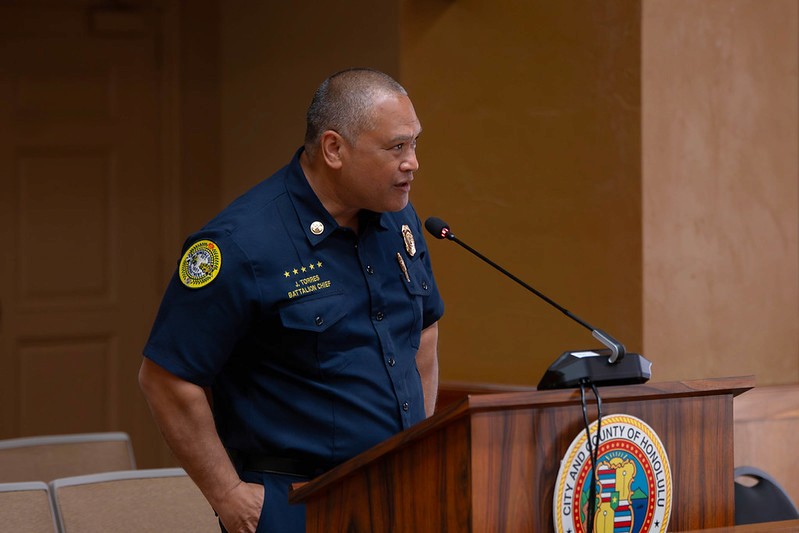
Battalion Chief Torres shares updates regarding the Honolulu Fire Department Fire. Photo Courtesy: Council Support Services / Justin Gerald Ocampo
How the Budget Process Works
The Council describes Honolulu's annual budget process in three phases.
Phase I: Preparation
The Mayor and administration prepare the executive operating budget, capital budget, and revenue program for the coming fiscal year. HART separately prepares its operating and capital budgets and submits them to the Council through the Mayor's office. At the same time, the Council Chair prepares the legislative budget for the legislative branch.
The Revised Charter requires the Mayor and Council to submit proposed executive and legislative budget documents at least 120 days before the end of the fiscal year. HART is required to submit its budgets through the Mayor's office by December 1 each year. The proposed budgets are usually submitted around March 2.
Phase II: Submittal, Review, Amendment, and Adoption
From March through June, the Council reviews the proposed budgets and revenue measures. This is the public's main opportunity to weigh in before adoption.
The Council can amend the proposed budgets and revenue measures. Councilmembers may propose changes based on district needs, department briefings, public testimony, fiscal analysis, or citywide priorities. Once the Council adopts the budget ordinances, they are subject to approval or veto by the Mayor. If the Mayor vetoes any item, the Council may consider an override where allowed.
Phase III: Administration and Enforcement
Once enacted, the budgets authorize agencies to spend funds. Operating appropriations are valid for one fiscal year. Capital improvement appropriations are valid for 24 months total, which is why the Council's review asks departments to be specific about project phases, schedules, and readiness.

The Honolulu City Council Convening for a Special Budget meeting on March 30, 2026. Photo Courtesy: Council Support Services / Justin Gerald Ocampo
Key FY27 Budget Dates
The Council's FY27 calendar sets out the budget review path:
March 2, 2026: Mayor's budgets due.
March 9, 2026: Administrative overview and department operating/CIP reviews begin.
March 10-12, 2026: Department operating and CIP budget reviews continue.
March 13, 2026: Contingency day for additional department review.
March 25, 2026: First reading of budget bills at Council.
March 30, 2026: Special CD1 budget meeting.
April 15, 2026: Second reading and public hearing on budget measures.
May 1, 2026: Special CD2 budget meeting.
June 3, 2026: Third reading of budget bills at Council.
June 15, 2026: Charter deadline for Council adoption of the budget and revenue program.
As of May 20, 2026, the process was still in motion, with final Council action scheduled for June.
Quick Reference: Major Measures
Measure | Purpose |
|---|---|
Bill 22 (2026) | Executive Operating Budget and Program for FY27 |
Bill 23 (2026) | Executive Capital Budget and Program for FY27 |
Bill 24 (2026) | General Obligation Bonds and Bond Anticipation Notes authorization |
Resolution 26-62 | Real property tax rates for FY27 |
Bill 26 (2026) | HART Operating Budget for FY27 |
Bill 27 (2026) | HART Capital Budget for FY27 |
Bill 28 (2026) | Legislative Budget for FY27 |
Category Tag:
Share this story
Subscribe to the District 9 mailing list
Receive mid-month and end of month updates, sent directly to your email!


